The arts are a necessity, albeit on a different level of Maslow’s hierarchy than food, water, shelter, and air. They provide creative outlets for self-expression, build community, improve mental health, and contribute to the region’s unique culture. They create jobs for artists and bring in around a billion dollars to the Houston economy. Still, it’s a challenge for arts organizations to balance affordable ticket prices with the need to keep their teams fed.
Houston Theater Week, which runs from August 24th through the 30th this year, offers buy-one-get-one-free tickets to stalwarts of the local scene, including Houston Ballet, 4th Wall Theatre Company, Alley Theatre, Stages, and Houston Grand Opera. Other arts nonprofits have adopted a pay-what-you-can pricing structure, either for a few shows per season or as the year-round default for ticket purchases.
It’s a simple concept. Rather than a set fee, those hoping to attend a show pay whatever their budget allows. This ensures that everybody who wants to experience local theater can. “There’s a lot of people who think it’s something out of their reach,” says Jennifer Decker, founder and artistic director of Mildred’s Umbrella Theater Company. “They’ve seen how expensive tickets are to the bigger venues and musicals especially, and a lot of people just won’t go because they can’t afford it.”
Founded in 2001, Mildred’s Umbrella performs what she describes as “avant-garde and original stuff,” but it wasn’t until around 2013 that the company began to focus more heavily on works by women playwrights. That’s when it also started its pay-what-you-can ticketing, a result of witnessing “a dip in ticket sales” following its mission change and the fact that students and actors, many of whom couldn’t afford the $25-$30 price point, comprised a large percentage of the audience.
Filling the crowd was a higher priority for Decker and her team than turning a profit, but they still needed money to maintain operations. So, they started offering a suggested price, allowing audiences to pay what they could afford. Alternatively, anyone who wanted to pay a little extra to support the theater had that option.
It’s a strategy that’s worked for Catastrophic Theatre as well. Co-founder Jason Nodler estimates that the average theater ticket in the city costs $55—outside most Houstonians’ budgets. Taking a cue from Chicago’s Theater Oobleck, the team sees pay-what-you-can as a way for Houstonians to explore their personal creative tastes without worrying about catching an overdraft along the way.
“We bring in a lot of non-traditional theater audiences, and so they may be coming to theater for the first time,” Nodler says. “Or, they may have seen a lot of theater and said, ‘You know what? That’s not really my thing.’…We’re trying to show them maybe there are other kinds [of shows] that might appeal to [them].”
Even though Catastrophic offers $0 tickets (“If you have nothing, please come,” Nodler says), they’ve noticed that people who can afford more than the suggested price often will pay more. Some tickets sell for $1.50. Others, $200. All sums are appreciated as “radical kindness,” Nodler says.
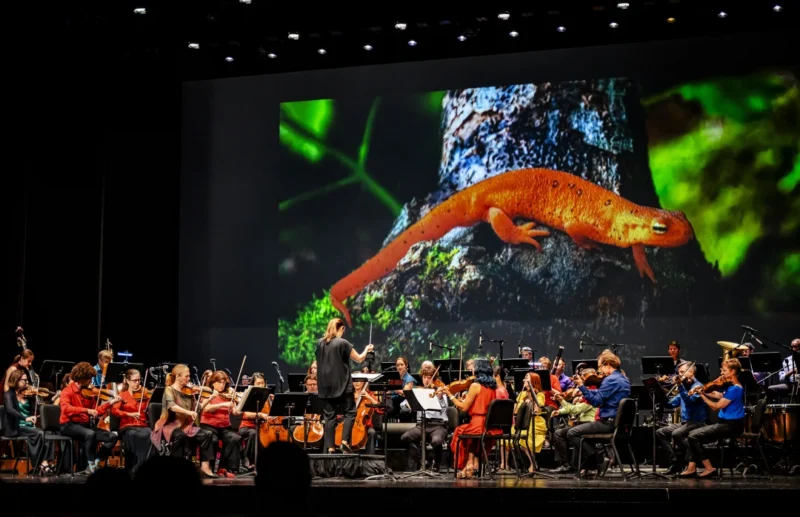
Theaters are not the only organizations that have adapted this ethos. In addition to choose-your-price ticketing (or, “pay-what-you-wish”), ROCO—Houston’s Chamber Orchestra—posts its shows online for free, giving anyone, anywhere access to world-class, often new and original, classical music.
For founder and director Alecia Lawyer, accessible admission to ROCO’s shows is her way to “solve the problem of loneliness.” More people can attend a performance and connect over a shared interest. Considering ROCO has performed at over 80 venues across the city, it also introduces audiences to new spots to explore together. “Third spaces have disappeared. And there’s this crisis of loneliness, not just in young people, but in the elderly, and it is mind-blowingly sad and heartbreaking,” she says.
Lawyer prefers the phrasing “pay what you wish,” so it doesn’t “sound like you’re putting the onus and judgment on the person that is trying to get the ticket.” Similarly, “pay what you want” feels to her like the onus is on the performing arts group, that the organization is essentially asking attendees what they think its labor is worth. “I know a lot of the things that I talk about are semantics, words. But they really are part of our culture,” she says. “I started ROCO as a human-first organization…You really are inviting people into the experience in a way that’s not transactional.”
Catastrophic has also refined how it presents its pay structure over time; the team doesn’t want to accidentally make anyone feel guilted into giving more than they can afford, Nodler says. Paying “delicate, careful” attention to messaging recently helped raise the average ticket price by $7. “People still sometimes get the feeling that they shouldn’t come because they can’t pay more, and that’s the opposite of the intention of the program,” he says.
Even if arts organizations can’t implement open-price ticketing for every performance, some still make it available for select shows. Garden Theatre, which operates out of Midtown Arts & Theater Center Houston (MATCH) alongside Catastrophic, typically offers set ticket prices to remain solvent, while striving to keep things as affordable and accessible as possible. This means no tickets over $30, flash sales, and offering complimentary shows to other nonprofit workers. Theater industry professionals are always given 50 percent off. This flexibility has yielded amazing results, says Logan Vaden, Garden Theatre’s founding artistic director.
“After the first couple [of] shows where we offered the pay-what-you-can nights, I would go back, and I would look at each performance and see what income we made on each performance,” Vaden says. “Without fail, almost every time, the pay-what-you-can performances are the highest income-earning shows.”
Regardless of whether an organization has adopted full- or part-time pay-what-you-can/wish ticketing, the benefits remain the same. Attending a show, regardless of budget, always helps. Along with private donations and generous Houstonians who can afford to pay hundreds of dollars per ticket, arts nonprofits depend on grants to keep them afloat. Decker points out that many grant applications ask for attendance numbers; the more attendees—no matter what they pay—the more likely an organization is to receive funding.
Thanks to pay-what-you-can ticketing, Decker says audiences at Mildred’s Umbrella have also become noticeably more heterogeneous—a mission that overlaps, in a way, with Lawyer’s desire to combat the loneliness epidemic through a shared joy of art across demographics. Younger people show up more often now, too, as do people who know little about theater and chamber music but wish to learn. “We try to match the diversity of the city with a mixture of people…and that includes the audience, too,” Decker says.

Leave A Reply